
Published paper - Future IoT: An Archetypal Model for Commerce Amongst Machines
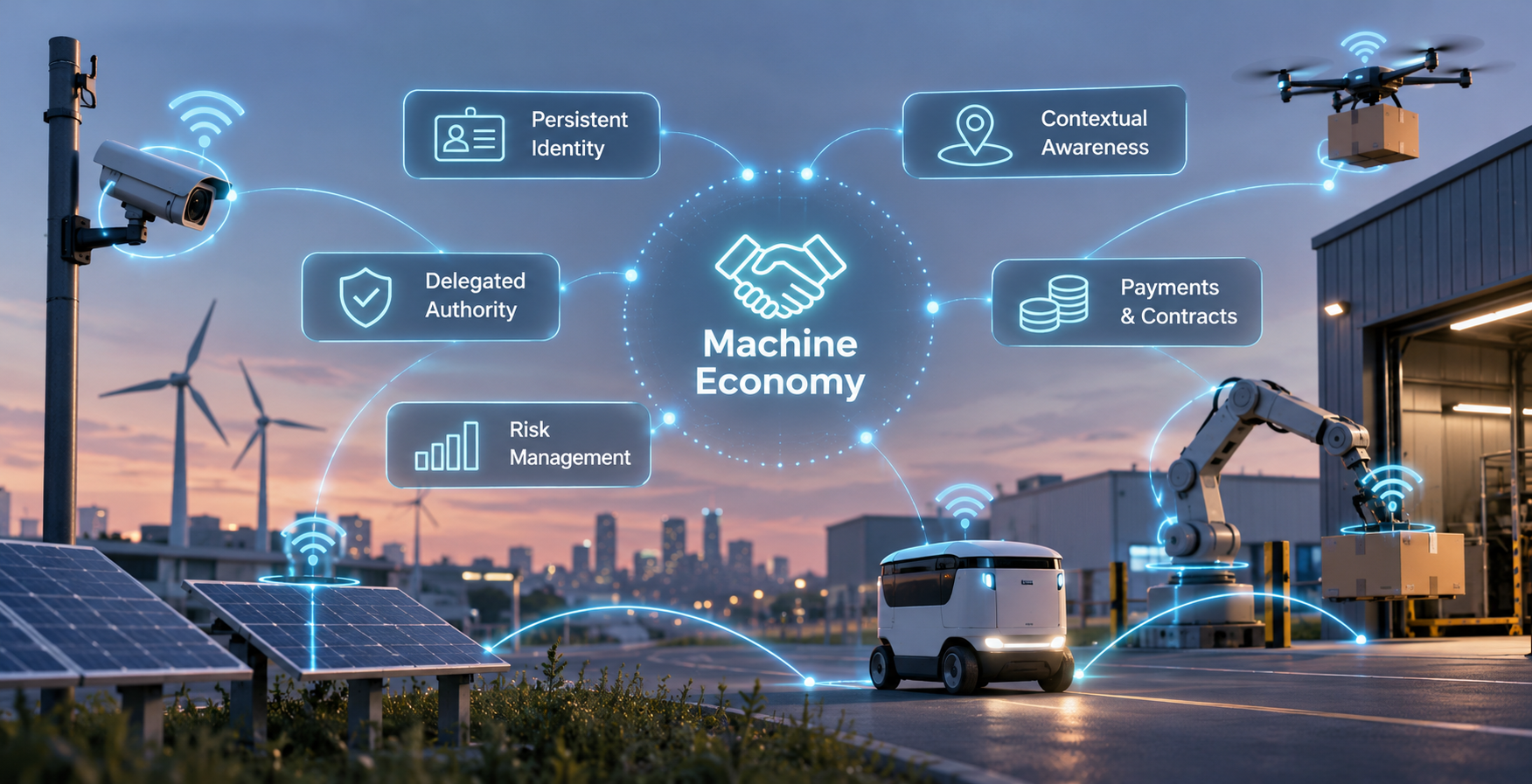
The Internet of Things (IoT) has traditionally been understood as a network of connected physical objects that sense their environments and communicate information to human users or enterprise applications. This paper argues that this conception is becoming inadequate. The next important stage of IoT development is likely to be characterised not merely by machines communicating with machines, but by machines participating in economic relationships with other machines. Connected assets will increasingly possess persistent identities, contextual awareness, delegated authority and access to payment, contracting and risk-management mechanisms. The result will be an emerging machine economy in which devices can request services, negotiate conditions, authorise expenditure, purchase resources, provide evidence of performance and initiate settlement with limited human intervention.

Agentic Commerce, Identity, and Global Economic Power in a Fragmenting World Order
The world economy is undergoing a profound digital transformation. At the heart of this shift it is anticipated that agentic commerce will play a central role this century.

The role of FinTech in the rise of a Multipolar Global System
The international system that emerged after the Second World War was anchored in a set of largely stable, interlocking principles, notably, territorial inviolability, a US-led security architecture, a rules-based multilateral framework, an open economic order centred on Western financial institutions, and normative commitments to human rights and self-determination.

BRICS+ : A Bloc in Motion
The BRICS alliance—originally composed of Brazil, Russia, India, China, and South Africa—has evolved from a symbolic economic acronym into a potentially transformative geopolitical bloc.

DORA: FinTechs and incumbents need to prepare for the impact of new regulations
Whether you're a FinTech disruptor, a DeFi innovator or an established player, the EU’s Digital Operational Resilience Act (DORA) will affect and reshape your business landscape through increased regulatory scrutiny and stricter third-party risk management.

De-dollarisation: Saudi Arabia’s Petrodollar exit and CBDC embrace
Saudi Arabia’s embrace of a multi-currency CBDC platform while simultaneously allowing its ‘Petrodollar agreement’ with the United States to expire calls into question whether the US dollar will be able to sustain its pre-eminence.

BloombergGPT: Domain-specific LLM
Are domain-specific Large Language Models the new emerging trend in AI adoption?

UK Artificial Intelligence Regulation
Will the UK's approach to regulating AI support or impede innovation?

Digital Twins & the Industrial Metaverse
Will the metaverse gain a new lease on life in the Web4 sphere?

Quantitative Destruction: Are we headed for next financial crisis?
It all begins with an idea.

What would Hayek make of Crypto?
Exploring the crypto disruption of money through a Hayek lens.

De-dollarisation: Broadening the Sino-Russian partnership to third countries
Systemic resistance continues with Sino-Russian exploitation of state-sponsored FinTech and third country currency swap agreements.

Is the Dollar’s influence in trade invoicing, a thing of the past?
De-dollarisation persists in a climate of ‘Global Systemic Resistance.’


Is the end nigh for crypto exchanges?
This may well spell the end of crypto exchanges, IEOs, DEXs and crypto-trading platforms as we know them.

The UK needs a CBDC, but why impose a £20k limit?
UK's 'Britcoin' CBDC may soften the Pound